

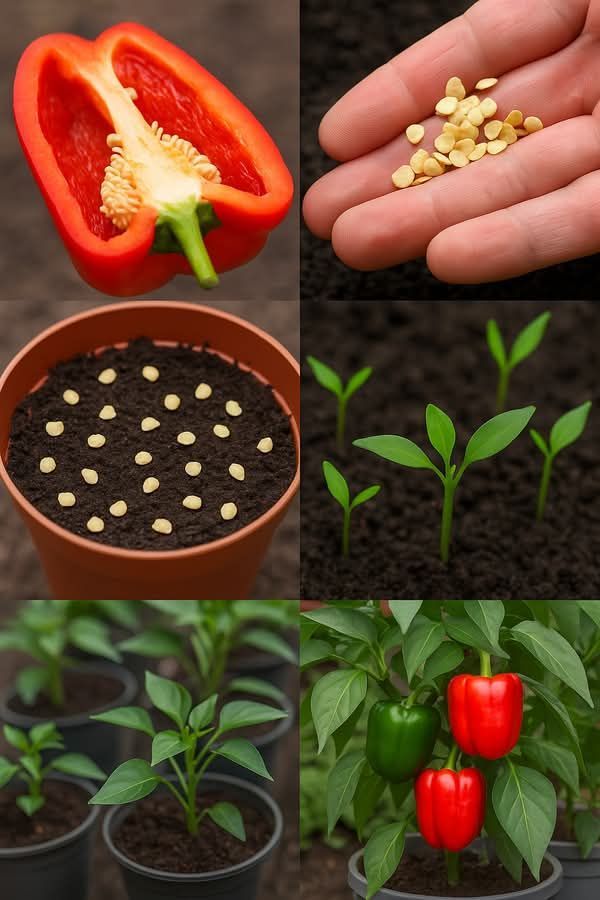
There is something immensely rewarding about harvesting vibrant, crisp bell peppers straight from your own garden. Whether you are adding sweet peppers to fresh summer salads, roasting them for family meals, or simply enjoying the colorful aesthetic of pepper plants on your balcony or patio, growing your own produce brings unmatched fresh flavor and satisfaction.
Many home gardeners assume that growing sweet peppers requires commercial seed packets, specialized greenhouse equipment, or advanced agricultural experience. In reality, you can successfully germinate seeds harvested directly from fresh, ripe bell peppers using simple household containers and basic potting soil. Let us explore the complete lifecycle of growing bell peppers from seed to harvest, examine essential soil and lighting conditions, and look at how home gardening supports long-term sustainable living.
Understanding the Lifecycle of a Bell Pepper Plant
Bell peppers (Capsicum annuum) belong to the Solanaceae (nightshade) family, sharing their ancestry with tomatoes, eggplants, and potatoes. Understanding their growth stages ensures you provide the right nutrients and environmental conditions at every step.
+--------------------------------------------------------+
|          Harvest & Extract Fresh Seeds from Pepper     |
+---------------------------+----------------------------+
                            |
                            v
+--------------------------------------------------------+
|    Sow Seeds in Moist Potting Mix & Maintain Warmth    |
+---------------------------+----------------------------+
                            |
                            v
+--------------------------------------------------------+
|     Seedlings Germinate & Develop True Leaves          |
+---------------------------+----------------------------+
                            |
                            v
+--------------------------------------------------------+
| Transplants Mature, Bloom Flowers & Set Fresh Fruit    |
+--------------------------------------------------------+
Stage 1: Seed Extraction and Preparation
The journey begins with selecting a fully ripe, high-quality sweet bell pepper—ideally red, yellow, or orange, as fully mature colored peppers contain fully developed, viable seeds.
- Extraction: Carefully slice around the stem core to release the internal seed pod without damaging individual seeds.
- Drying: While fresh seeds can be planted immediately, allowing seeds to air-dry on a paper towel for 24 to 48 hours helps prevent fungal issues during germination.
Stage 2: Germination and Early Sprouting
Pepper seeds require warm soil temperatures—ideally between $75^\circ\text{F}$ and $85^\circ\text{F}$ ($24^\circ\text{C}$ to $29^\circ\text{C}$)—to break dormancy. When sown shallowly in well-draining seed starting mix and kept consistently moist, green cotyledons (first leaves) usually emerge within 7 to 14 days.
Step-by-Step Planting Instructions
Achieving high germination rates and robust seedling growth comes down to consistency, proper soil drainage, and adequate sunlight.
1. Preparing the Soil and Container
Fill a seed-starting tray or small nursery pot with a light, sterile potting blend composed of peat moss, perlite, and coconut coir. Avoid using heavy garden soil for indoor seed starting, as dense dirt can compact around delicate tender roots and restrict air movement.
2. Sowing the Seeds
Press seeds into the damp soil about $1/4$ inch deep, spacing them evenly to avoid immediate overcrowding. Lightly cover with fine soil and mist gently with water to ensure good seed-to-soil contact.
3. Light and Moisture Management
Place the container in a warm location. Once sprouts break through the surface, immediately transfer them to a bright windowsill or beneath indoor LED grow lights. Seedlings require 12 to 16 hours of strong light daily to prevent them from becoming leggy and weak.
4. Potting Up and Transplanting
When seedlings grow two to three sets of “true leaves” (the secondary leaves that resemble adult pepper leaves), gently separate individual seedlings and transplant them into larger individual 4-inch containers.
Comparing Growing Methods: Indoor Containers vs. Outdoor Gardens
Depending on your living situation, home size, and climate, sweet peppers adapt exceptionally well to both container gardening and open garden beds.
| Growing Environment | Best Suited For | Key Advantages | Primary Maintenance Focus |
| Container Gardening | Balconies, urban apartments, small patios | Mobile, easy pest control, efficient space use | Requires frequent watering and balanced liquid fertilizer. |
| Outdoor Raised Beds | Suburban homes, spacious yards | High yield per plant, deep root expansion space | Requires mulch layer for soil temperature and weed control. |
| Indoor Hydroponics | Year-round growing in urban settings | Fast growth rate, complete nutrient control | Requires upfront investment in lighting and technology. |
Home Gardening as a Value-Driven Lifestyle Choice
Cultivating edible plants at home is far more than a relaxing hobby; it represents a meaningful investment in personal well-being, environmental sustainability, and household resourcefulness.
As consumer interest in organic nutrition and local food security continues to expand, home gardening offers families an educational, practical skill. Teaching children how food grows supports practical education in biology and nutrition, while reducing reliance on long-distance grocery supply chains. Furthermore, spending time caring for plants and connecting with natural cycles is widely recognized for its positive impact on mental health and stress relief.