

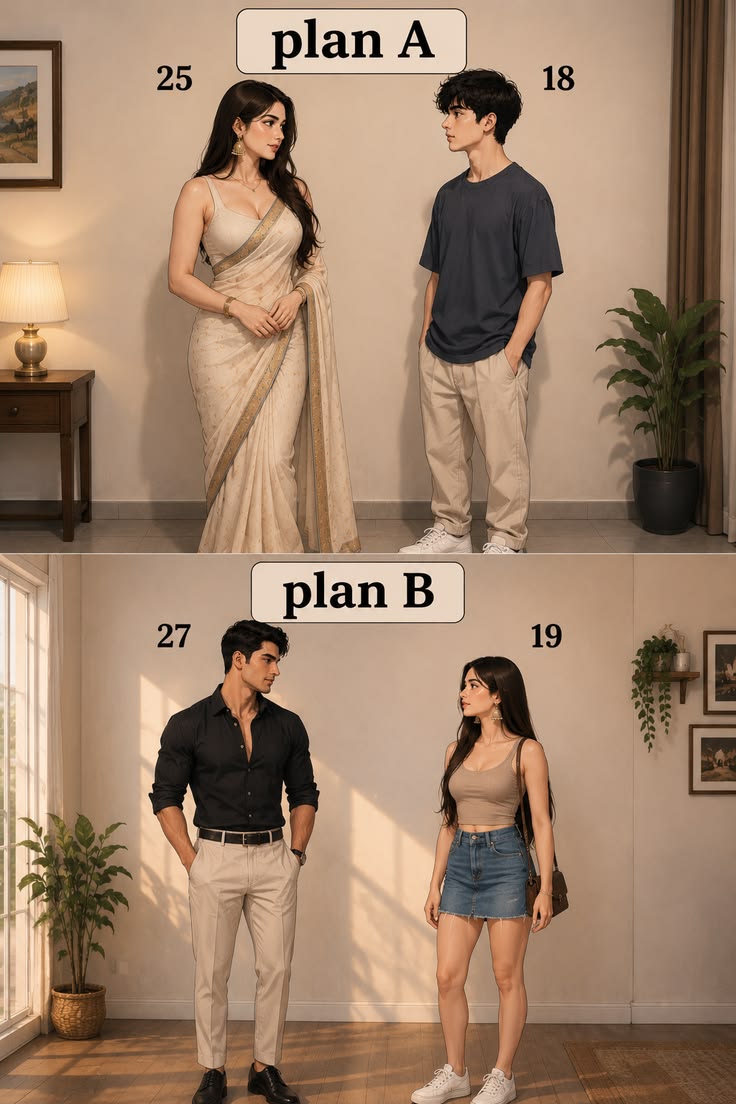
In the graphic above, two distinct scenarios are labeled plan A and plan B:
- Plan A: A 25-year-old woman dressed in elegant traditional attire (saree) paired with an 18-year-old man in casual street clothing.
- Plan B: A 27-year-old man in sharp business-casual attire paired with a 19-year-old woman in casual summer wear (crop top and denim skirt).
In this article, we break down the elements of both scenarios, examining maturity levels, social perceptions, and key factors in relationship compatibility.
Breakdown of the Two Scenarios
Comparing the visual presentation and age dynamics in both options highlights key social and psychological considerations.
+--------------------------------------------------------+
|               Relationship Dynamic Scan                |
+---------------------------+----------------------------+
                            |
                            v
+--------------------------------------------------------+
|  Plan A (Older Female)    |  Plan B (Older Male)       |
|  - Woman: 25 years old    |  - Man: 27 years old       |
|  - Man: 18 years old      |  - Woman: 19 years old     |
|  - Traditional / Casual   |  - Formal / Contemporary   |
+--------------------------------------------------------+
1. Plan A: Older Female (25) & Younger Male (18)
- Age Gap: 7-year difference.
- Life Stage: A 25-year-old is generally establishing a career and independence, whereas an 18-year-old is typically entering college or beginning adulthood.
- Visual Style: The woman wears traditional attire representing elegance and maturity, while the man wears a oversized t-shirt, relaxed trousers, and sneakers.
- Social Perception: Relationships where the woman is significantly older are less common in traditional media, though increasingly accepted in modern social contexts.
2. Plan B: Older Male (27) & Younger Female (19)
- Age Gap: 8-year difference.
- Life Stage: A 27-year-old man is typically well into his professional career, while a 19-year-old woman is at the start of young adulthood.
- Visual Style: The man wears a black button-down shirt, tailored trousers, and dress shoes, while the woman wears a casual tank top and denim skirt with sneakers.
- Social Perception: This setup follows a more conventional social archetype where the male partner is older and more established in his career.
Direct Comparison Matrix
| Parameter | Plan A | Plan B |
| Partner Ages | Woman (25) / Man (18) | Man (27) / Woman (19) |
| Age Difference | 7 Years | 8 Years |
| Female Attire | Elegant traditional saree | Casual top & denim skirt |
| Male Attire | Oversized t-shirt & chinos | Fitted button-down shirt & slacks |
| Primary Dynamic | Older woman / Younger man | Older man / Younger woman |
Life Stages, Personal Well-Being, and Maturity
Evaluating age differences in relationships involves looking past initial aesthetics to focus on long-term compatibility factors.
Developing emotional intelligence and shared values supports relationship health and personal stability. Aligning on long-term goals—such as career ambitions in business, financial management, homeownership in real estate, and eventual life planning toward retirement—plays a vital role in building a sustainable future together regardless of age differences.
Key Factors in Relationship Compatibility
- Shared Life Stages: Differences in daily routine, financial independence, and career goals can create challenges if partners are at completely different phases of life.
- Communication & Maturity: Emotional maturity and effective communication matter far more than age numbers alone.
- Mutual Respect: Healthy relationships require equal partnership, shared values, and mutual support across all life decisions.
Conclusion
Whether considering Plan A or Plan B, modern relationships depend on mutual respect, shared values, and emotional alignment rather than rigid age conventions or visual archetypes.
Which perspective do you agree with? Share your thoughts in the comments below!
FAQ Section
What is the age gap in Plan A vs. Plan B?
Plan A features a 7-year gap (25 and 18), while Plan B features an 8-year gap (27 and 19).
Why do life stages matter in young adult relationships?
Between ages 18 and 27, individuals undergo significant transitions—including finishing education, starting careers, and achieving financial independence—which can influence relationship priorities.
What determines long-term relationship success?
Shared goals, emotional maturity, clear communication, and mutual respect are the foundational elements of a lasting partnership.
Social discussion graphics comparing age gaps and relationship pairings frequently generate active debate online. These visual prompts typically contrast two scenarios with different age distributions and aesthetic styles to examine how society views relationship dynamics, maturity, and lifestyle alignment.
In the graphic above, two distinct scenarios are labeled plan A and plan B:
- Plan A: A 25-year-old woman dressed in elegant traditional attire (saree) paired with an 18-year-old man in casual street clothing.
- Plan B: A 27-year-old man in sharp business-casual attire paired with a 19-year-old woman in casual summer wear (crop top and denim skirt).
In this article, we break down the elements of both scenarios, examining maturity levels, social perceptions, and key factors in relationship compatibility.
Breakdown of the Two Scenarios
Comparing the visual presentation and age dynamics in both options highlights key social and psychological considerations.
+--------------------------------------------------------+
|               Relationship Dynamic Scan                |
+---------------------------+----------------------------+
                            |
                            v
+--------------------------------------------------------+
|  Plan A (Older Female)    |  Plan B (Older Male)       |
|  - Woman: 25 years old    |  - Man: 27 years old       |
|  - Man: 18 years old      |  - Woman: 19 years old     |
|  - Traditional / Casual   |  - Formal / Contemporary   |
+--------------------------------------------------------+
1. Plan A: Older Female (25) & Younger Male (18)
- Age Gap: 7-year difference.
- Life Stage: A 25-year-old is generally establishing a career and independence, whereas an 18-year-old is typically entering college or beginning adulthood.
- Visual Style: The woman wears traditional attire representing elegance and maturity, while the man wears a oversized t-shirt, relaxed trousers, and sneakers.
- Social Perception: Relationships where the woman is significantly older are less common in traditional media, though increasingly accepted in modern social contexts.
2. Plan B: Older Male (27) & Younger Female (19)
- Age Gap: 8-year difference.
- Life Stage: A 27-year-old man is typically well into his professional career, while a 19-year-old woman is at the start of young adulthood.
- Visual Style: The man wears a black button-down shirt, tailored trousers, and dress shoes, while the woman wears a casual tank top and denim skirt with sneakers.
- Social Perception: This setup follows a more conventional social archetype where the male partner is older and more established in his career.
Direct Comparison Matrix
| Parameter | Plan A | Plan B |
| Partner Ages | Woman (25) / Man (18) | Man (27) / Woman (19) |
| Age Difference | 7 Years | 8 Years |
| Female Attire | Elegant traditional saree | Casual top & denim skirt |
| Male Attire | Oversized t-shirt & chinos | Fitted button-down shirt & slacks |
| Primary Dynamic | Older woman / Younger man | Older man / Younger woman |
Life Stages, Personal Well-Being, and Maturity
Evaluating age differences in relationships involves looking past initial aesthetics to focus on long-term compatibility factors.
Developing emotional intelligence and shared values supports relationship health and personal stability. Aligning on long-term goals—such as career ambitions in business, financial management, homeownership in real estate, and eventual life planning toward retirement—plays a vital role in building a sustainable future together regardless of age differences.
Key Factors in Relationship Compatibility
- Shared Life Stages: Differences in daily routine, financial independence, and career goals can create challenges if partners are at completely different phases of life.
- Communication & Maturity: Emotional maturity and effective communication matter far more than age numbers alone.
- Mutual Respect: Healthy relationships require equal partnership, shared values, and mutual support across all life decisions.
Conclusion
Whether considering Plan A or Plan B, modern relationships depend on mutual respect, shared values, and emotional alignment rather than rigid age conventions or visual archetypes.
Which perspective do you agree with? Share your thoughts in the comments below!
FAQ Section
What is the age gap in Plan A vs. Plan B?
Plan A features a 7-year gap (25 and 18), while Plan B features an 8-year gap (27 and 19).
Why do life stages matter in young adult relationships?
Between ages 18 and 27, individuals undergo significant transitions—including finishing education, starting careers, and achieving financial independence—which can influence relationship priorities.
What determines long-term relationship success?
Shared goals, emotional maturity, clear communication, and mutual respect are the foundational elements of a lasting partnership.