

Who Should You Save First? The Ethics and Psychology of Life-or-Death Dilemmas
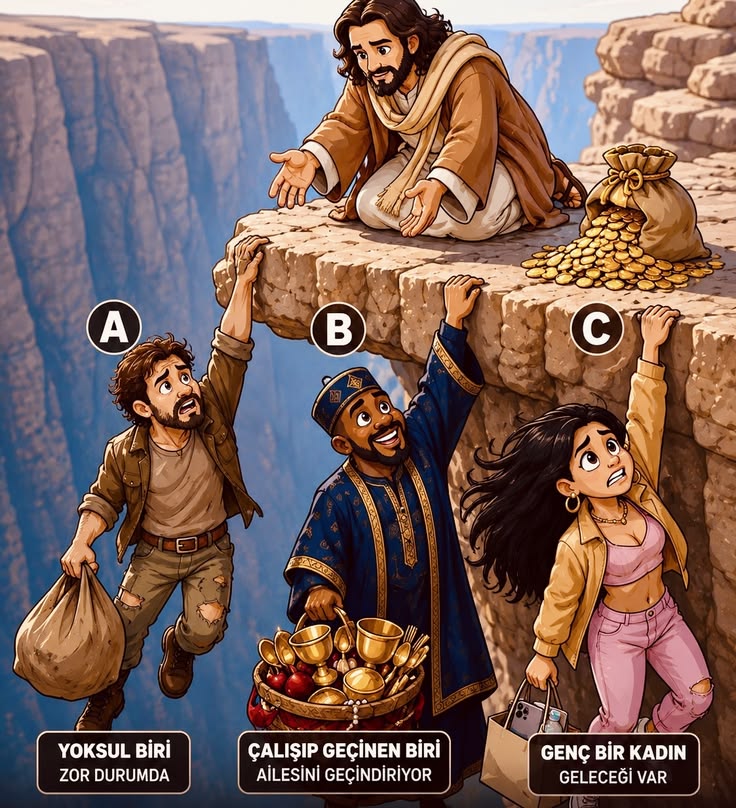
Moral choice puzzles and ethical dilemmas have long been used in philosophy, cognitive science, and social media discussions to examine how human beings prioritize life, duty, and compassion under pressure. A striking visual example depicts three individuals dangling from a dangerous cliff edge, each holding on with a single hand while carrying a distinct item, with a rescuer positioned above them at the ledge:
- Person A: A poor or struggling individual who is in dire hardship (Yoksul biri – Zor durumda).
- Person B: A hardworking provider carrying goods to support their family (Çalışıp geçinen biri – Ailesini geçindiriyor).
- Person C: A young woman with her whole life and potential future ahead of her (Genç bir kadın – Geleceği var).
When time, physical reach, or energy limits a rescuer to helping one person at a time, how do we evaluate who to prioritize? In this comprehensive article, we will analyze the philosophical frameworks surrounding moral choice, evaluate the ethical arguments for saving each individual, and look at how critical decision-making applies to real-world emergency situations.
Deconstructing the Dilemma: Ethical Frameworks
Philosophers and ethicists utilize standardized thought experiments to understand how different human values drive decision-making when resources or time are strictly limited.
+--------------------------------------------------------+
|          Faced with a High-Stakes Moral Choice         |
+---------------------------+----------------------------+
                            |
                            v
+--------------------------------------------------------+
|    Evaluate Competing Ethical Perspectives & Values    |
|   (Utilitarianism, Duty Ethics, Social Need, Potential)  |
+---------------------------+----------------------------+
                            |
                            v
+--------------------------------------------------------+
|     Analyze Immediate Physical Feasibility & Risk      |
+---------------------------+----------------------------+
                            |
                            v
+--------------------------------------------------------+
|  Deduce Systematic Action Strategy for Saving Lives    |
+--------------------------------------------------------+
1. Utilitarianism: Maximizing Overall Well-Being
Utilitarian ethics, championed by philosophers like John Stuart Mill, suggest that the most moral action is the one that minimizes total suffering and maximizes overall happiness for the greatest number of people.
- Under a utilitarian lens, Person B might be prioritized because saving a family breadwinner directly prevents the severe hardship, poverty, and suffering of their dependent family members.
- Alternatively, Person C might be chosen because preserving a young person’s life maximizes the total number of quality years lived and future societal contributions.
2. Prioritarianism and Compassion: Helping the Most Vulnerable
The prioritarian perspective emphasizes giving moral weight to those who are worst off or in the greatest immediate distress.
- From this viewpoint, Person A represents someone already facing severe hardship and vulnerability, making immediate assistance a matter of fundamental human dignity and targeted relief.
3. Deontology and Equal Human Worth
Deontological ethics (associated with Immanuel Kant) hold that all human lives possess intrinsic, equal value regardless of their age, social status, wealth, or family obligations. From a strict deontological standpoint, no individual’s life is inherently “more valuable” than another’s.
Evaluating Arguments for Each Option
Every choice in this dilemma reflects a specific human value or social priority.
| Candidate | Visual & Context Clues | Primary Ethical Justification | Core Value Represented |
| Person A | Poor individual in severe difficulty | Protecting the most vulnerable; equity and immediate compassion. | Vulnerability & Relief |
| Person B | Hardworking family provider | Secondary impact; protecting dependent family members from tragedy. | Duty & Family Support |
| Person C | Young woman with a long future ahead | Maximizing long-term life potential and future years lived. | Youth & Future Potential |
Practical Emergency Realities: Triage and Rescue Logistics
While philosophical thought experiments isolate moral values, real-world emergency search-and-rescue teams (such as first responders and medical professionals) rely on objective triage protocols rather than subjective moral evaluations.
1. Proximity and Reaching the Nearest Person
In an active physical crisis, emergency responders do not pause to evaluate a person’s background, profession, or future potential. The gold standard in physical rescue is simple: save the person closest or easiest to secure first to prevent immediate loss of life, then proceed immediately to the next individual.
2. Dropping Extra Weight
From a practical safety perspective, anyone dangling from a cliff edge with a single hand should immediately drop heavy hand-held items (bags, baskets, or possessions) to reduce grip strain and improve their survival chances while waiting for assistance.
The Broader Impact of Moral Reasoning in Daily Life
Engaging with ethical dilemmas helps individuals sharpen their decision-making skills across professional, personal, and societal domains.
- Healthcare and Medical Triage: Medical teams continually apply structured ethical principles when allocating limited ICU beds, organ transplants, or emergency care during crisis situations.
- Business Leadership and Corporate Governance: Executive leaders in business weigh competing stakeholder needs, balancing immediate economic stability with long-term community impact.
- Legal Systems and Public Policy: Legal services professionals and policymakers craft regulations that balance individual rights against overall public safety and social welfare.
Practical Tips for Making Tough Decisions Under Pressure
- Focus on Objective Facts First: Separate emotional assumptions from verifiable physical facts and immediate risks.
- Identify Downstream Effects: Consider how a decision impacts not just the immediate parties involved, but also dependents, families, and broader communities.
- Establish Clear Prioritization Principles: Pre-determined principles (such as proximity, immediate risk level, or equal opportunity) prevent panic during fast-moving situations.
Fascinating Facts About Ethics and Triage
- Origin of Medical Triage: The word triage originates from the French verb trier (meaning “to sort”). It was developed on military battlefields during the Napoleonic Wars by surgeon Dominique Jean Larrey to prioritize medical treatment based on injury severity rather than military rank.
- The Trolley Problem: Formulated by philosopher Philippa Foot in 1967, the Trolley Problem remains one of the most famous ethical thought experiments, exploring the conflict between utilitarian outcomes and moral duties.
- Artificial Intelligence Ethics: Modern engineers developing autonomous vehicles utilize ethical choice scenarios to program safety algorithms for unexpected collision avoidance.
Conclusion
Moral dilemmas like “Who Should You Save First?” offer far more than simple debate—they challenge us to examine the foundational values that guide our choices. Whether prioritizing the most vulnerable, supporting family providers, or preserving future potential, every answer reflects a deep commitment to human life.
In practical emergency scenarios, swift action based on physical feasibility and proximity saves lives. Exploring these thought experiments sharpens our empathy, analytical reasoning, and decision-making skills in every aspect of life.
FAQ Section
Is there a single “correct” answer to this moral puzzle?
No. Philosophically, there is no universally correct choice, as each option represents a valid, recognized ethical perspective (such as utilitarianism, duty ethics, or prioritarianism).
How do real first responders handle multiple victims in danger?
Real emergency responders use objective triage protocols based on physical proximity, immediate threat severity, and rescue feasibility, rather than evaluating personal or social characteristics.
Why are moral choice puzzles popular on social media?
Ethical puzzles encourage active engagement because they trigger fundamental personal values, allowing people to share diverse perspectives and debate complex human scenarios.