

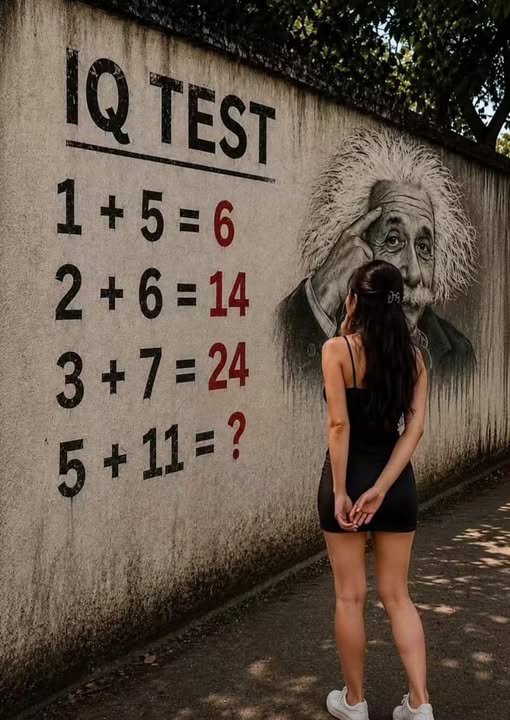
Mathematical logic puzzles and sequence riddles frequently go viral across social media because they challenge standard order-of-operations rules by replacing traditional addition with hidden functional patterns. These brain teasers test algebraic reasoning, pattern recognition, and lateral thinking.
In the mural graphic above, a street art portrait of Albert Einstein is accompanied by an “IQ TEST” sequence:
- $1 + 5 = 6$
- $2 + 6 = 14$
- $3 + 7 = 24$
- $5 + 11 = ?$
In this comprehensive guide, we will break down the underlying mathematical rule step-by-step and reveal the correct answer for $5 + 11$.
Step-by-Step Logic and Pattern Analysis
To solve non-standard arithmetic sequences, we evaluate how the inputs on the left side of the equals sign transform to produce the output on the right side.
+--------------------------------------------------------+
|              Formula Pattern Identification            |
+---------------------------+----------------------------+
                            |
                            v
+--------------------------------------------------------+
|  Equation Rule: A + B -> (A x B) + A  or  A x (B + 1)  |
+---------------------------+----------------------------+
                            |
                            v
+--------------------------------------------------------+
| 1 + 5 -> (1 x 5) + 1 = 6                               |
| 2 + 6 -> (2 x 6) + 2 = 14                              |
| 3 + 7 -> (3 x 7) + 3 = 24                              |
| 5 + 11 -> (5 x 11) + 5 = 60                            |
+--------------------------------------------------------+
1. Identifying the Primary Algebraic Rule
Let the first term be $A$ and the second term be $B$.
Applying the algebraic transformation $f(A, B) = A \times B + A$ (or equivalently $A \times (B + 1)$):
- Line 1: $1 + 5 \implies (1 \times 5) + 1 = 5 + 1 = 6$
- Line 2: $2 + 6 \implies (2 \times 6) + 2 = 12 + 2 = 14$
- Line 3: $3 + 7 \implies (3 \times 7) + 3 = 21 + 3 = 24$
2. Solving for the Final Line ($5 + 11$)
Applying the established formula $A \times B + A$ directly to the values $A = 5$ and $B = 11$:
$$\text{Result} = (5 \times 11) + 5 = 55 + 5 = 60$$
Alternatively, using $A \times (B + 1)$:
$$\text{Result} = 5 \times (11 + 1) = 5 \times 12 = 60$$
Comparison Table of Solution Approaches
Depending on how one interprets sequence gaps, a few secondary interpretations exist, though the primary direct formula yields the definitive standard answer.
| Method / Interpretation | Formula | Calculation Steps | Final Answer |
| Direct Product + First Term (Standard) | $A \times B + A$ | $(5 \times 11) + 5 = 55 + 5$ | 60 |
| Incremented Multiplier | $A \times (B + 1)$ | $5 \times (11 + 1) = 5 \times 12$ | 60 |
| Cumulative Sum (With Intermediate Line $4+8$) | $(A \times B + A) + \text{Previous}$ | $24 + (4 \times 8 + 4) = 60$, then $60 + (5 \times 11 + 5)$ | 120 |
Cognitive Benefits of Logic Puzzles
Engaging with abstract math riddles and numerical sequence puzzles provides valuable workout for the brain’s problem-solving centers.
Developing mental flexibility and pattern recognition enhances analytical skills in everyday decision-making. In professional environments, sharp logical reasoning supports sound strategic planning in business, data-driven risk assessment in personal finance, and long-term security management toward retirement. Regularly exercising your analytical mind keeps cognitive faculties sharp across all stages of life.
Practical Tips for Solving Math Sequence Riddles
- Test Simple Transformations: Start by testing basic operations: $A \times B + A$, $A \times B – A$, or $(A + B) \times A$.
- Check Consistency: Ensure your derived formula works seamlessly across every given line, not just the first or second.
- Watch for Jumped Sequences: Notice if consecutive numbers skip steps (such as jumping from $3$ to $5$), which indicates whether a direct formula or cumulative sequence is required.
Conclusion
By applying the algebraic pattern $A \times B + A$ consistently across all given equations, the solution to $5 + 11$ is 60.
Did you solve it on your first try? Share this IQ puzzle with friends and family to test their math logic skills!
FAQ Section
What is the correct answer to the 5 + 11 puzzle?
The primary correct answer is 60, calculated using the formula $(A \times B) + A$.
How does the formula work for 2 + 6 = 14?
Multiply the two numbers ($2 \times 6 = 12$) and then add the first number ($12 + 2 = 14$).
Why isn’t standard addition used?
These visual “IQ test” puzzles use addition symbols as abstract operators representing a hidden function rather than conventional arithmetic.