

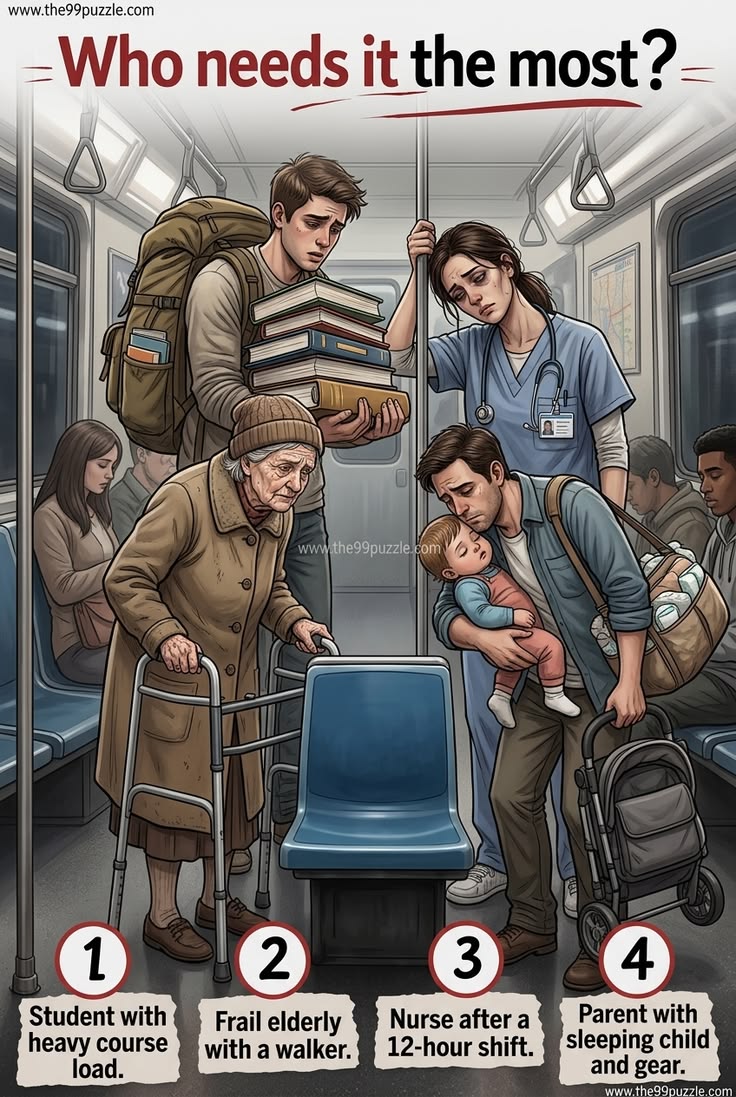
Social moral dilemmas and public transit scenarios are popular visual discussions that explore empathy, physical necessity, and transit etiquette rules. These situations present a common scenario: a crowded subway or bus with a single open priority seat and multiple passengers in varying states of fatigue or physical need.
In the illustration above, four individuals are standing near an empty priority seat:
- Student with heavy course load: Carrying a large backpack and a heavy stack of textbooks.
- Frail elderly person with a walker: Using a mobility frame for balance and support.
- Nurse after a 12-hour shift: Wearing medical scrubs and showing visible exhaustion.
- Parent with sleeping child and gear: Holding an infant while carrying a diaper bag and stroller.
In this article, we will examine official public transit priority rules, physical safety considerations, and the moral arguments surrounding each choice.
Breakdown of the Four Passengers
Public transit guidelines and physical mobility standards offer clear criteria for evaluating seated priority.
+--------------------------------------------------------+
|             Transit Priority Evaluation                |
+---------------------------+----------------------------+
                            |
                            v
+--------------------------------------------------------+
| 1. Student (Heavy Load)   | 2. Elderly Person (Walker) |
| - High stamina / fatigue  | - High fall risk / safety  |
| 3. Nurse (Exhaustion)     | 4. Parent with Sleeping Baby|
| - High fatigue / standing | - Balance risk with infant |
+--------------------------------------------------------+
1. Passenger 1: Student with Heavy Course Load
- Situation: Carrying a heavy stack of books and a full backpack.
- Physical Need: Experiencing physical fatigue and strain from carrying heavy objects on a moving train.
- Priority Status: While carrying weight is exhausting, standard transit rules categorize healthy young adults carrying luggage or supplies under general accommodation rather than reserved priority.
2. Passenger 2: Frail Elderly Person with a Walker
- Situation: An elderly individual relying on a four-legged walker for stability on a moving transit vehicle.
- Physical Need: Extremely high fall risk. Sudden braking or sharp turns by the vehicle could cause severe injury or loss of balance.
- Priority Status: Highest Official Priority. Transit regulations universally designate priority seating for elderly individuals and people with physical mobility impairments.
3. Passenger 3: Nurse After a 12-Hour Shift
- Situation: A healthcare worker standing after an exhausting 12-hour shift.
- Physical Need: High mental and physical exhaustion, sore feet, and low energy levels.
- Priority Status: Highly deserving of social empathy and community care, though standard transit rules prioritize immediate physical safety and mobility limitations first.
4. Passenger 4: Parent with Sleeping Child and Gear
- Situation: Holding a sleeping baby in one arm while managing a shoulder bag and a stroller.
- Physical Need: Managing dual weight and potential balance hazards while supporting a vulnerable child.
- Priority Status: High social and practical priority. Holding an infant while standing on a moving train poses stability challenges.
Priority Matrix Comparison
Evaluating each situation based on transit safety regulations versus social empathy:
| Passenger | Primary Challenge | Transit Rule Priority | Safety & Fall Risk Level | Recommended Outcome |
| 1. Student | Carrying heavy books | Standard Passenger | Low | Can place books on the floor |
| 2. Elderly Person | Limited mobility / Walker reliance | Highest Priority (Designated) | Critical / High Risk | Receives the Seat |
| 3. Nurse | 12-hour shift fatigue | Social Courtesy | Low–Moderate | High empathy, but lower safety risk |
| 4. Parent & Child | Carrying infant & gear | High Courtesy / Special Needs | Moderate–High | Secondary candidate for seating |
Community Courtesy, Safety, and Everyday Wellbeing
Resolving public transit dilemmas reflects how communities balance safety, empathy, and practical necessity.
Prioritizing physical safety for vulnerable individuals promotes community health and reduces preventable injuries in public spaces. In daily life, observing structured etiquette and mutual respect strengthens personal integrity, which translates into positive professional relations in business and responsible long-term planning for retirement. Simple acts of everyday courtesy foster a supportive society.
Key Principles of Public Transit Etiquette
- Follow Priority Signs: Priority seats are legally designated for elderly passengers, pregnant women, people with disabilities, and individuals with injuries.
- Offer Seats Proactively: Look up from screens or books at stops to offer seats to passengers needing balance support.
- Set Down Heavy Loads: Passengers carrying heavy items or backpacks should place them on the floor between their feet to reduce fatigue and free up space.
Conclusion
From an official transit safety and accessibility perspective, Passenger 2 (Frail elderly person with a walker) needs the seat the most due to the immediate risk of fall or injury on a moving vehicle. However, in an ideal community setting, nearby seated passengers would offer additional seats so the nurse and parent could also rest!
Who would you offer the seat to first? Share your thoughts and join the discussion!
FAQ Section
Who has the legal right to priority seating on public transit?
Designated priority seating is reserved by transit law for seniors, pregnant women, and individuals with disabilities or mobility limitations.
Why does the elderly person take precedence over the nurse or parent?
Because of fall risk. A sudden stop can cause severe harm to an elderly person holding onto a walker, whereas standing poses a lower physical danger to dynamic balance.
How can passengers resolve crowded seating situations fairly?
Seated passengers who are able-bodied should offer their standard seats to tired parents or healthcare workers, reserving designated priority spots for those with mobility aids.