She wasn’t part of this trip. It was my family vacation, my gift to my son and his family. I had paid for everything—every ticket, every room, every activity—with the money I had earned over four decades of fourteen-hour shifts, midnight emergencies, and early morning rounds.
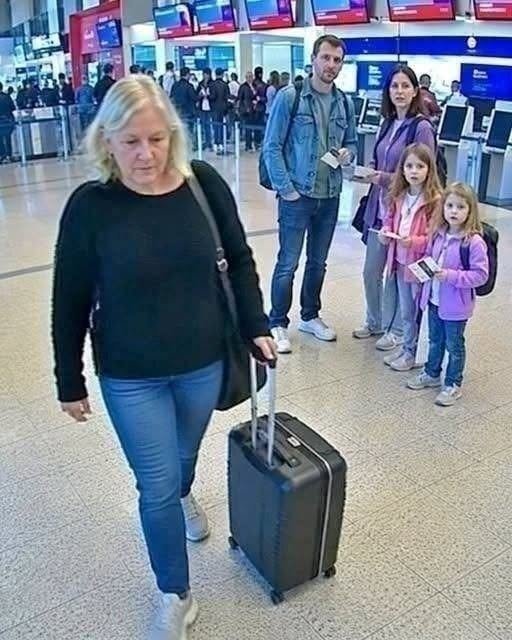
I approached, forcing a smile.
“Good morning,” she exclaimed cheerfully. “Is everyone ready for paradise?”
Tyler and Emma looked at me, but they didn’t rush over like they usually did. Tyler gave me a quick, forced smile. Emma clutched the handle of her suitcase.
Jessica turned towards me, with a strangely expressionless face.
I’m not enthusiastic about it. It doesn’t excite me.
Cold.
“Margaret, there has been a change of planes,” he said.
I stopped, my hand still gripping the handle of the suitcase, my fingers suddenly numb.
“Airplane change?” I repeated. I heard my own voice in the distance, as if it were coming through a hospital intercom.
Jessica sighed as if it was already causing her discomfort.
“We gave your ticket to my mother,” he said, bowing his head toward Linda. “The children love her more and deserve a vacation. You understand, right?”
For a moment, I thought I’d misheard her. Maybe it was the noise. Maybe it was the flight announcements echoing off the high ceiling. Maybe she’d said something about the rental car, the type of room, something else entirely.
“What did you say?” he asked.
Jessica’s tone remained informal, almost bored, as if she were rearranging dinner reservations and not rewriting a forty-seven thousand dollar family trip that I had planned down to the last detail, including the snorkel fin.
“We’ve changed your reservation,” he said. “Linda will go in your place. You can go home.” He smiled as if it were reasonable, even generous. “The grandchildren love her more. They’re closer to her. It makes sense for her to be the one at the beach with them.”
The sentence shocked me more than any blunt force trauma I’ve ever seen on a CT scan.
I turned to Kevin.
For thirty-eight years, I watched the emotions reflected on my son’s face as if I were observing the waves of an electrocardiogram on a monitor. Fear, joy, teenage arrogance, the naiveté of first love, the quiet pride when he opened his Northwestern acceptance letter. I know every facet of that face.
The version that stared back at me in O’Hare was one I had never seen before.
Avoidance.
Cowardice.
“Kevin,” I said. “Tell me this is a joke.”
He changed his posture, staring intently over my shoulder at a United poster as if he wanted to disappear into it.
“Mom, that makes sense,” she murmured. “Linda hardly ever has time to be with the kids. You see them all the time. It’s just a trip.”
Just one trip.
The trip I had planned for six months. The trip I had paid for forty-seven thousand dollars for. The trip I had envisioned as the great Hayes family memory, the one my grandchildren would talk about long after I was gone.
“Just one trip,” I repeated.
Jessica crossed her arms over her designer sports jacket.
“We already changed the reservation with the dryer,” she said. “Linda’s seat is confirmed. Your ticket is canceled. Look, it’s not that big of a deal, Margaret. Stop exaggerating. Anyway, you’re too old for Hawaii. With all that sun and activity, you’d only slow us down.”
Too old.
I am sixty-seven years old. I have opened chests at three in the morning and repaired beating hearts while residents half my age nearly fainted. I run six kilometers three times a week along the path that borders the lake, dodging cyclists and college students. I can climb the stairs to the top of the museum grounds without stopping.
But for my daughter-in-law, I was “too old” to sit by the pool watching my grandchildren play.
I looked at Tyler and Emma, hoping—praying—to see some hint of confusion, some slight crease in their frown that would indicate that they, too, were upset.
They stared at the ground.
Their small carry-on bags stood firm beside them like loyal soldiers. Tyler bit his lip. Emma twisted the sleeve of her summer dress. Someone had clearly told them not to say anything.
My grandchildren, whom I had imagined splashing around beside me in the Pacific, weren’t even looking at me.
Around us, the bustle of O’Hare Airport shifted. A couple at the next check-in counter slowed down their phone. A TSA agent glanced at us and then quickly looked away. A teenager in a Chicago Bulls sweatshirt watched the spectacle openly.
“It’s not that big of a deal,” Jessica repeated, brushing the invisible lint off her clothes. “We’ll send you photos of the trip.”
She really said that.
We will send you photos of the trip you paid for, the trip you are being excluded from as if you were a tumor.
I froze, feeling my heart race. It didn’t reach dangerous levels; I know those numbers well. Just enough to remind me I was angry.
Grandpa said I shouldn’t tell anyone yet.
I felt like my whole body was freezing.
What is it that you shouldn’t tell me?
She remained silent. At that moment, Robert entered the room. When he saw the bag in my hands, he turned pale.
“You weren’t supposed to find that,” he said.
I took Emily in my arms and she immediately left the room.
I barely slept that night. Daniel insisted we should talk to his father before drawing any conclusions, but I no longer trusted any explanation Robert could give me.
The next morning I installed a small hidden camera in the living room. It was pointed towards the hallway, and the bathroom door was closed. I needed to know what was happening while I was away.
At work, I was watching the camera feed on my phone all day. At 3:40 pm, Robert drove Emily home from school. She wasn’t running like before. He was walking slowly, holding one hand at his side.


 safaegym