

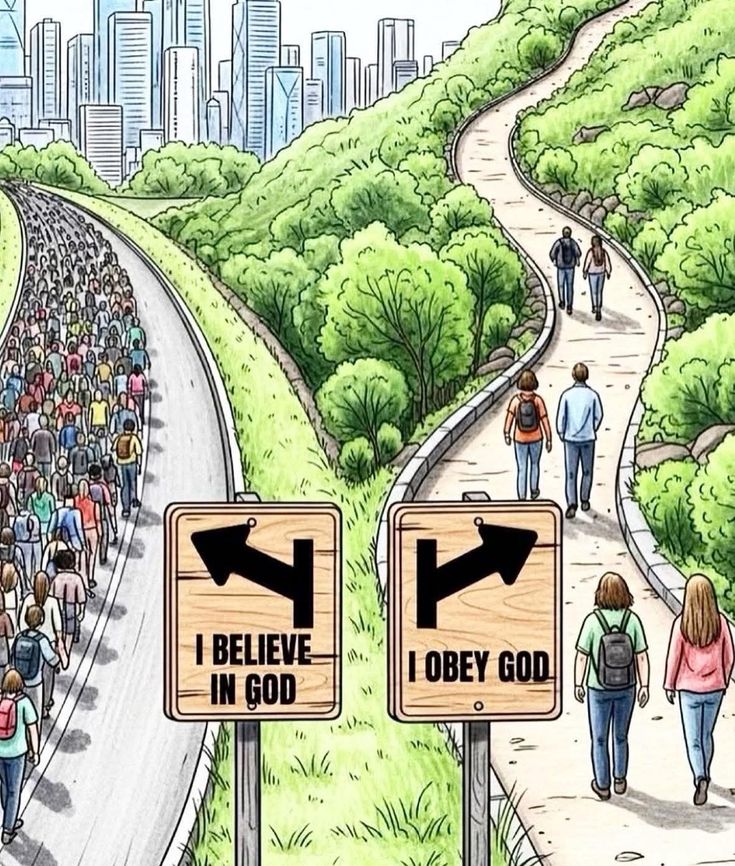
The left road, labeled “I BELIEVE IN GOD,” shows a wide, densely packed highway heading toward a bustling cityscape. In contrast, the right road, labeled “I OBEY GOD,” depicts a narrower, quiet path winding up a green hill with only a few travelers. In this article, we will examine the visual symbolism, theological themes, and real-world implications of this conceptual illustration.
Visual Metaphor and Symbolic Breakdown
The illustration uses classic artistic contrast to convey its message about personal conviction versus active practice.
+--------------------------------------------------------+
|                   The Fork in the Road                 |
+---------------------------+----------------------------+
                            |
                            v
+--------------------------------------------------------+
|  Left Path: "I Believe in God"  | Right Path: "I Obey God" |
|  - Wide, paved highway          | - Narrow, winding trail  |
|  - Massive crowd of travelers   | - Few deliberate walkers |
|  - Leads toward city landscape  | - Leads up peaceful hill |
+--------------------------------------------------------+
1. The Left Path: “I Believe in God”
- Visual Elements: A broad, well-paved road crowded with a large mass of people walking toward an urban skyline.
- Symbolic Meaning: Represents passive belief or superficial affiliation—an easy, widely traveled route requiring minimal individual sacrifice or personal discipline. It illustrates how assent to a belief system is common, but may not necessarily change one’s daily path.
2. The Right Path: “I Obey God”
- Visual Elements: A narrow, scenic, winding trail ascending through greenery, walked by only a small number of deliberate travelers.
- Symbolic Meaning: Represents active faith, ethical obedience, and personal commitment. This path reflects the idea that living strictly according to moral commandments or spiritual principles requires individual choice, effort, and perseverance.
Philosophical and Theological Contexts
This visual imagery closely mirrors famous allegories and spiritual texts across diverse philosophical traditions:
| Path Attribute | “I Believe in God” (Left) | “I Obey God” (Right) |
| Path Width | Wide and spacious | Narrow and winding |
| Foot Traffic | Dense crowd / Popular consensus | Few individuals / Selective journey |
| Core Concept | Intellectual agreement or passive identity | Actionable commitment and ethical living |
| Biblical Parallel | “Broad is the road…” (Matthew 7:13-14) | “Narrow is the gate…” (Matthew 7:13-14) |
| Key Distinction | Faith as a statement | Faith as a lifestyle |
Personal Alignment, Ethics, and Daily Purpose
Reflecting on the distinction between belief and action encourages personal introspection in every aspect of life.
Cultivating personal integrity and living according to core principles supports overall mental wellness, inner peace, and personal health. In professional and financial spheres, aligning actions with values leads to disciplined decision-making, sound finance management, and responsible long-term planning for key milestones like real estate investment or comfortable retirement. Actions consistently defining our path yield lasting compound rewards.
Key Takeaways from the Illustration
- Words vs. Actions: Professing belief is accessible to many, but actively embodying moral tenets requires conscious, daily effort.
- The Power of Choice: The visual fork in the road emphasizes that spiritual and moral development is driven by individual choices rather than following the crowd.
- Quality Over Quantity: A narrow path walked by a focused few often symbolizes deeper spiritual commitment and authenticity.
Conclusion
The “I Believe in God” versus “I Obey God” illustration serves as a powerful reminder that true conviction is demonstrated through daily choices, moral actions, and personal discipline rather than passive agreement.
Which path resonates most with your personal journey? Share your thoughts and reflections with friends and family!
FAQ Section
What is the main message of the “I Believe in God / I Obey God” image?
The image illustrates the difference between passive faith (simply stating a belief) and active faith (living according to moral principles and divine guidance).
What biblical passage does this image reference?
It references Matthew 7:13–14, which contrasts the broad road that many travel with the narrow path that leads to life.
Why is the “I Obey God” path depicted with fewer people?
It symbolizes that taking the disciplined, ethical path often requires more personal commitment and effort, leading fewer people to choose it compared to the popular or easy path.
In religious philosophy and spiritual discourse, a fundamental distinction is often drawn between professing faith and actively living out moral principles. This thematic contrast is vividly illustrated in the visual metaphor above, where two distinct roads represent different approaches to spirituality.
The left road, labeled “I BELIEVE IN GOD,” shows a wide, densely packed highway heading toward a bustling cityscape. In contrast, the right road, labeled “I OBEY GOD,” depicts a narrower, quiet path winding up a green hill with only a few travelers. In this article, we will examine the visual symbolism, theological themes, and real-world implications of this conceptual illustration.
Visual Metaphor and Symbolic Breakdown
The illustration uses classic artistic contrast to convey its message about personal conviction versus active practice.
+--------------------------------------------------------+
|                   The Fork in the Road                 |
+---------------------------+----------------------------+
                            |
                            v
+--------------------------------------------------------+
|  Left Path: "I Believe in God"  | Right Path: "I Obey God" |
|  - Wide, paved highway          | - Narrow, winding trail  |
|  - Massive crowd of travelers   | - Few deliberate walkers |
|  - Leads toward city landscape  | - Leads up peaceful hill |
+--------------------------------------------------------+
1. The Left Path: “I Believe in God”
- Visual Elements: A broad, well-paved road crowded with a large mass of people walking toward an urban skyline.
- Symbolic Meaning: Represents passive belief or superficial affiliation—an easy, widely traveled route requiring minimal individual sacrifice or personal discipline. It illustrates how assent to a belief system is common, but may not necessarily change one’s daily path.
2. The Right Path: “I Obey God”
- Visual Elements: A narrow, scenic, winding trail ascending through greenery, walked by only a small number of deliberate travelers.
- Symbolic Meaning: Represents active faith, ethical obedience, and personal commitment. This path reflects the idea that living strictly according to moral commandments or spiritual principles requires individual choice, effort, and perseverance.
Philosophical and Theological Contexts
This visual imagery closely mirrors famous allegories and spiritual texts across diverse philosophical traditions:
| Path Attribute | “I Believe in God” (Left) | “I Obey God” (Right) |
| Path Width | Wide and spacious | Narrow and winding |
| Foot Traffic | Dense crowd / Popular consensus | Few individuals / Selective journey |
| Core Concept | Intellectual agreement or passive identity | Actionable commitment and ethical living |
| Biblical Parallel | “Broad is the road…” (Matthew 7:13-14) | “Narrow is the gate…” (Matthew 7:13-14) |
| Key Distinction | Faith as a statement | Faith as a lifestyle |
Personal Alignment, Ethics, and Daily Purpose
Reflecting on the distinction between belief and action encourages personal introspection in every aspect of life.
Cultivating personal integrity and living according to core principles supports overall mental wellness, inner peace, and personal health. In professional and financial spheres, aligning actions with values leads to disciplined decision-making, sound finance management, and responsible long-term planning for key milestones like real estate investment or comfortable retirement. Actions consistently defining our path yield lasting compound rewards.
Key Takeaways from the Illustration
- Words vs. Actions: Professing belief is accessible to many, but actively embodying moral tenets requires conscious, daily effort.
- The Power of Choice: The visual fork in the road emphasizes that spiritual and moral development is driven by individual choices rather than following the crowd.
- Quality Over Quantity: A narrow path walked by a focused few often symbolizes deeper spiritual commitment and authenticity.
Conclusion
The “I Believe in God” versus “I Obey God” illustration serves as a powerful reminder that true conviction is demonstrated through daily choices, moral actions, and personal discipline rather than passive agreement.
Which path resonates most with your personal journey? Share your thoughts and reflections with friends and family!
FAQ Section
What is the main message of the “I Believe in God / I Obey God” image?
The image illustrates the difference between passive faith (simply stating a belief) and active faith (living according to moral principles and divine guidance).
What biblical passage does this image reference?
It references Matthew 7:13–14, which contrasts the broad road that many travel with the narrow path that leads to life.
Why is the “I Obey God” path depicted with fewer people?
It symbolizes that taking the disciplined, ethical path often requires more personal commitment and effort, leading fewer people to choose it compared to the popular or easy path.