

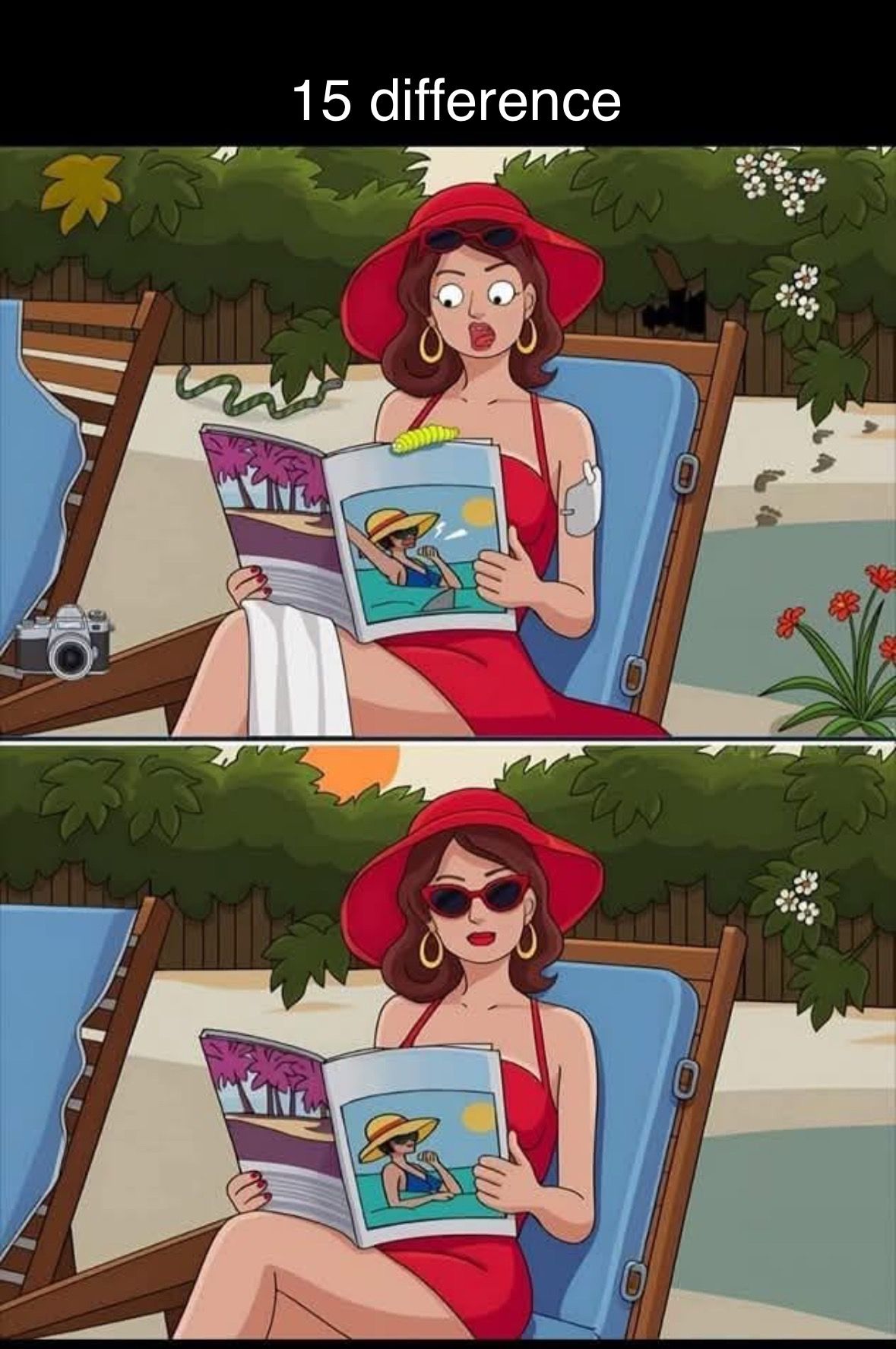
In the illustration above, a woman in a red hat and dress relaxes in a lounge chair while reading a magazine. While both panels share a similar core layout, a meticulous side-by-side inspection reveals 15 distinct differences between the top and bottom panels. In this article, we map out every single change step-by-step.
Complete Breakdown of All 15 Differences
A systematic scan from the background vegetation down to the foreground furniture reveals every modification made between the two panels.
+--------------------------------------------------------+
|             Systematic Visual Scan (Top to Bottom)     |
+---------------------------+----------------------------+
                            |
                            v
+--------------------------------------------------------+
|  Top Background & Fence   |  Woman, Glasses & Magazine |
|  - Setting Sun           |  - Sunglasses Position     |
|  - White Flowers & Hole   |  - Mouth / Expression      |
|  - Footprints & Snake     |  - Patch & Caterpillar     |
|  - Red Flowers & Camera   |  - Shark Fin in Magazine   |
+--------------------------------------------------------+
1. The Sun in the Sky
- Top Panel: The sky in the background is clear blue with green leaves.
- Bottom Panel: The top of an orange setting sun is visible behind the leaves near the center.
2. Snake on the Fence / Chair
- Top Panel: A green snake is slithering along the wooden fence behind the left chair back.
- Bottom Panel: The snake is completely absent.
3. Hole in the Wooden Fence
- Top Panel: There is a dark broken hole in the wooden fence on the far right side.
- Bottom Panel: The fence panel is whole and undamaged.
4. White Flowers on the Right Bush
- Top Panel: Two clusters of white flowers are blooming on the green hedge on the right.
- Bottom Panel: The top cluster of white flowers is missing, leaving only one cluster.
5. Footprints in the Sand
- Top Panel: A trail of footprints is visible in the sand path behind the right side of the lounge chair.
- Bottom Panel: The sand path is smooth with no footprints.
6. Red Flowers on the Right
- Top Panel: Red flowers are blooming in the lower-right foreground next to the pool.
- Bottom Panel: The red flowers have been removed.
7. Camera on the Left Chair
- Top Panel: A silver camera sits resting on the wooden frame of the left lounge chair.
- Bottom Panel: The camera is missing.
8. White Towel over the Woman’s Lap
- Top Panel: A white towel drapes over the woman’s lap beneath the magazine.
- Bottom Panel: The white towel is completely gone.
9. Green Caterpillar on the Magazine
- Top Panel: A bright green caterpillar rests on the top edge of the open magazine.
- Bottom Panel: The caterpillar is absent.
10. Shark Fin in the Magazine Picture
- Top Panel: In the magazine image, a gray shark fin pokes out of the blue water near the swimmer.
- Bottom Panel: The shark fin in the magazine artwork is missing.
11. Woman’s Sunglasses
- Top Panel: The woman wears red cat-eye sunglasses pushed up on her forehead above her eyes.
- Bottom Panel: She is wearing the sunglasses over her eyes.
12. Facial Expression / Eyes
- Top Panel: Her eyes are wide open in surprise, looking downward over her glasses.
- Bottom Panel: Her eyes are covered by the sunglasses.
13. Mouth Expression
- Top Panel: Her mouth is open in a shocked “O” shape with visible red lips.
- Bottom Panel: Her mouth is closed with a calm expression.
14. Medical / Adhesive Patch on Arm
- Top Panel: A white square adhesive patch (like a monitor or bandage) is stuck to her upper left arm.
- Bottom Panel: Her upper left arm is completely bare.
15. Yellow Palm Tree Leaf Color
- Top Panel: The palm leaf in the upper-left corner is fully bright yellow/green.
- Bottom Panel: The leaves in the upper-left corner match the surrounding dark green foliage.
Itemized Checklist Table
Comparing both panels side-by-side provides a clear visual summary of all 15 changes:
| # | Element / Location | Top Panel | Bottom Panel |
| 1 | Upper Sky | No visible sun | Orange sun setting behind leaves |
| 2 | Wooden Fence (Left) | Green snake present | Snake removed |
| 3 | Wooden Fence (Right) | Broken dark hole in fence | Intact wooden fence |
| 4 | Right Hedge | 2 clusters of white flowers | 1 cluster of white flowers |
| 5 | Sand Path (Right) | Trail of footprints present | Smooth sand with no prints |
| 6 | Lower Right Corner | Red flowers blooming | Red flowers removed |
| 7 | Left Lounge Chair | Silver camera on frame | No camera |
| 8 | Woman’s Lap | White towel draped under magazine | White towel removed |
| 9 | Magazine Edge | Green caterpillar on top edge | Caterpillar removed |
| 10 | Magazine Illustration | Shark fin in the water | No shark fin |
| 11 | Sunglasses Position | Pushed up on forehead | Worn over eyes |
| 12 | Eyes / Expression | Wide, surprised eyes visible | Eyes covered by sunglasses |
| 13 | Mouth | Open in shock (“O” shape) | Closed, neutral expression |
| 14 | Upper Left Arm | White adhesive patch attached | Bare arm |
| 15 | Upper-Left Foliage | Distinct yellow-tinged leaf | Uniform green foliage |
Cognitive and Perceptual Benefits of Image Puzzles
Engaging with detailed visual search challenges provides an effective workout for the brain’s visual processing centers.
Practicing visual discrimination sharpens mental acuity, spatial awareness, and attention to detail. In daily life and professional settings, strong observational habits enhance quality control in business operations, proofreading efficiency, and data verification. Making visual riddles a regular pastime helps preserve cognitive flexibility and focus well into retirement.
Practical Tips for Spotting All 15 Differences Fast
- Scan by Quadrants: Divide the picture into four horizontal strips (background sky, fence level, character details, and foreground chairs) and compare each zone methodically.
- Check Character Accessories: Examine clothing, eyewear, body marks, and handheld items first, as character edits are primary targets for puzzle designers.
- Look Inside Sub-Images: Don’t forget to check artwork within artwork—such as photos, posters, or open magazine pages!
Conclusion
Finding all 15 differences in this sunbathing scenario requires sharp eyes—from background elements like the setting sun and hidden snake to fine details like the shark fin in the magazine and the patch on her arm!
How many differences did you manage to catch on your first scan? Share this visual challenge with friends and family to test their observation skills!
FAQ Section
What are the hardest differences to find in this puzzle?
The hardest differences to spot are the subtle leaf color change in the upper-left corner, the small shark fin inside the magazine artwork, and the single cluster of missing white flowers on the right hedge.
Why are 15-difference puzzles more challenging than standard 5-difference puzzles?
Higher-count puzzles require scanning secondary and tertiary background objects rather than focusing solely on main characters, forcing the viewer to maintain prolonged visual focus.
How does “change blindness” affect puzzle solving?
Change blindness occurs when the brain overlooks visual edits because it focuses on the overall scene meaning rather than verifying individual line details and color shifts.
Visual observation riddles and spot-the-difference challenges offer an engaging way to test detail scanning, short-term visual memory, and focused concentration. These puzzles prompt viewers to systematically compare two side-by-side or stacked panels to identify subtle edits, missing objects, color changes, and altered details.
In the illustration above, a woman in a red hat and dress relaxes in a lounge chair while reading a magazine. While both panels share a similar core layout, a meticulous side-by-side inspection reveals 15 distinct differences between the top and bottom panels. In this article, we map out every single change step-by-step.
Complete Breakdown of All 15 Differences
A systematic scan from the background vegetation down to the foreground furniture reveals every modification made between the two panels.
+--------------------------------------------------------+
|             Systematic Visual Scan (Top to Bottom)     |
+---------------------------+----------------------------+
                            |
                            v
+--------------------------------------------------------+
|  Top Background & Fence   |  Woman, Glasses & Magazine |
|  - Setting Sun           |  - Sunglasses Position     |
|  - White Flowers & Hole   |  - Mouth / Expression      |
|  - Footprints & Snake     |  - Patch & Caterpillar     |
|  - Red Flowers & Camera   |  - Shark Fin in Magazine   |
+--------------------------------------------------------+
1. The Sun in the Sky
- Top Panel: The sky in the background is clear blue with green leaves.
- Bottom Panel: The top of an orange setting sun is visible behind the leaves near the center.
2. Snake on the Fence / Chair
- Top Panel: A green snake is slithering along the wooden fence behind the left chair back.
- Bottom Panel: The snake is completely absent.
3. Hole in the Wooden Fence
- Top Panel: There is a dark broken hole in the wooden fence on the far right side.
- Bottom Panel: The fence panel is whole and undamaged.
4. White Flowers on the Right Bush
- Top Panel: Two clusters of white flowers are blooming on the green hedge on the right.
- Bottom Panel: The top cluster of white flowers is missing, leaving only one cluster.
5. Footprints in the Sand
- Top Panel: A trail of footprints is visible in the sand path behind the right side of the lounge chair.
- Bottom Panel: The sand path is smooth with no footprints.
6. Red Flowers on the Right
- Top Panel: Red flowers are blooming in the lower-right foreground next to the pool.
- Bottom Panel: The red flowers have been removed.
7. Camera on the Left Chair
- Top Panel: A silver camera sits resting on the wooden frame of the left lounge chair.
- Bottom Panel: The camera is missing.
8. White Towel over the Woman’s Lap
- Top Panel: A white towel drapes over the woman’s lap beneath the magazine.
- Bottom Panel: The white towel is completely gone.
9. Green Caterpillar on the Magazine
- Top Panel: A bright green caterpillar rests on the top edge of the open magazine.
- Bottom Panel: The caterpillar is absent.
10. Shark Fin in the Magazine Picture
- Top Panel: In the magazine image, a gray shark fin pokes out of the blue water near the swimmer.
- Bottom Panel: The shark fin in the magazine artwork is missing.
11. Woman’s Sunglasses
- Top Panel: The woman wears red cat-eye sunglasses pushed up on her forehead above her eyes.
- Bottom Panel: She is wearing the sunglasses over her eyes.
12. Facial Expression / Eyes
- Top Panel: Her eyes are wide open in surprise, looking downward over her glasses.
- Bottom Panel: Her eyes are covered by the sunglasses.
13. Mouth Expression
- Top Panel: Her mouth is open in a shocked “O” shape with visible red lips.
- Bottom Panel: Her mouth is closed with a calm expression.
14. Medical / Adhesive Patch on Arm
- Top Panel: A white square adhesive patch (like a monitor or bandage) is stuck to her upper left arm.
- Bottom Panel: Her upper left arm is completely bare.
15. Yellow Palm Tree Leaf Color
- Top Panel: The palm leaf in the upper-left corner is fully bright yellow/green.
- Bottom Panel: The leaves in the upper-left corner match the surrounding dark green foliage.
Itemized Checklist Table
Comparing both panels side-by-side provides a clear visual summary of all 15 changes:
| # | Element / Location | Top Panel | Bottom Panel |
| 1 | Upper Sky | No visible sun | Orange sun setting behind leaves |
| 2 | Wooden Fence (Left) | Green snake present | Snake removed |
| 3 | Wooden Fence (Right) | Broken dark hole in fence | Intact wooden fence |
| 4 | Right Hedge | 2 clusters of white flowers | 1 cluster of white flowers |
| 5 | Sand Path (Right) | Trail of footprints present | Smooth sand with no prints |
| 6 | Lower Right Corner | Red flowers blooming | Red flowers removed |
| 7 | Left Lounge Chair | Silver camera on frame | No camera |
| 8 | Woman’s Lap | White towel draped under magazine | White towel removed |
| 9 | Magazine Edge | Green caterpillar on top edge | Caterpillar removed |
| 10 | Magazine Illustration | Shark fin in the water | No shark fin |
| 11 | Sunglasses Position | Pushed up on forehead | Worn over eyes |
| 12 | Eyes / Expression | Wide, surprised eyes visible | Eyes covered by sunglasses |
| 13 | Mouth | Open in shock (“O” shape) | Closed, neutral expression |
| 14 | Upper Left Arm | White adhesive patch attached | Bare arm |
| 15 | Upper-Left Foliage | Distinct yellow-tinged leaf | Uniform green foliage |
Cognitive and Perceptual Benefits of Image Puzzles
Engaging with detailed visual search challenges provides an effective workout for the brain’s visual processing centers.
Practicing visual discrimination sharpens mental acuity, spatial awareness, and attention to detail. In daily life and professional settings, strong observational habits enhance quality control in business operations, proofreading efficiency, and data verification. Making visual riddles a regular pastime helps preserve cognitive flexibility and focus well into retirement.
Practical Tips for Spotting All 15 Differences Fast
- Scan by Quadrants: Divide the picture into four horizontal strips (background sky, fence level, character details, and foreground chairs) and compare each zone methodically.
- Check Character Accessories: Examine clothing, eyewear, body marks, and handheld items first, as character edits are primary targets for puzzle designers.
- Look Inside Sub-Images: Don’t forget to check artwork within artwork—such as photos, posters, or open magazine pages!
Conclusion
Finding all 15 differences in this sunbathing scenario requires sharp eyes—from background elements like the setting sun and hidden snake to fine details like the shark fin in the magazine and the patch on her arm!
How many differences did you manage to catch on your first scan? Share this visual challenge with friends and family to test their observation skills!
FAQ Section
What are the hardest differences to find in this puzzle?
The hardest differences to spot are the subtle leaf color change in the upper-left corner, the small shark fin inside the magazine artwork, and the single cluster of missing white flowers on the right hedge.
Why are 15-difference puzzles more challenging than standard 5-difference puzzles?
Higher-count puzzles require scanning secondary and tertiary background objects rather than focusing solely on main characters, forcing the viewer to maintain prolonged visual focus.
How does “change blindness” affect puzzle solving?
Change blindness occurs when the brain overlooks visual edits because it focuses on the overall scene meaning rather than verifying individual line details and color shifts.